Store-Bought Air Purifiers vs. Professional Air Purification — What's the Difference?
Both sit in your home and move air. The similarity mostly ends there. Here is what actually separates a consumer air purifier from a professionally specified and installed air purification system — and when each one is the right tool.
Walk into any big-box store or scroll through any online retailer and you will find dozens of air purifiers at a wide range of price points, each promising cleaner air, fresher breathing, and a healthier home. The marketing is compelling, the price points are accessible, and the products are easy to set up and use.
Professional air purification — specified by an IAQ professional, sized to the property, and integrated with the HVAC system or installed at calibrated locations throughout the space — rarely comes up in the same conversation. Most people are not aware it exists as a distinct category, let alone that the difference between the two is significant enough to matter for their specific situation.
This article is not an argument that consumer air purifiers are useless. They are not. It is an explanation of what each category is actually designed to do, where each performs well, and where the gap between them becomes consequential.
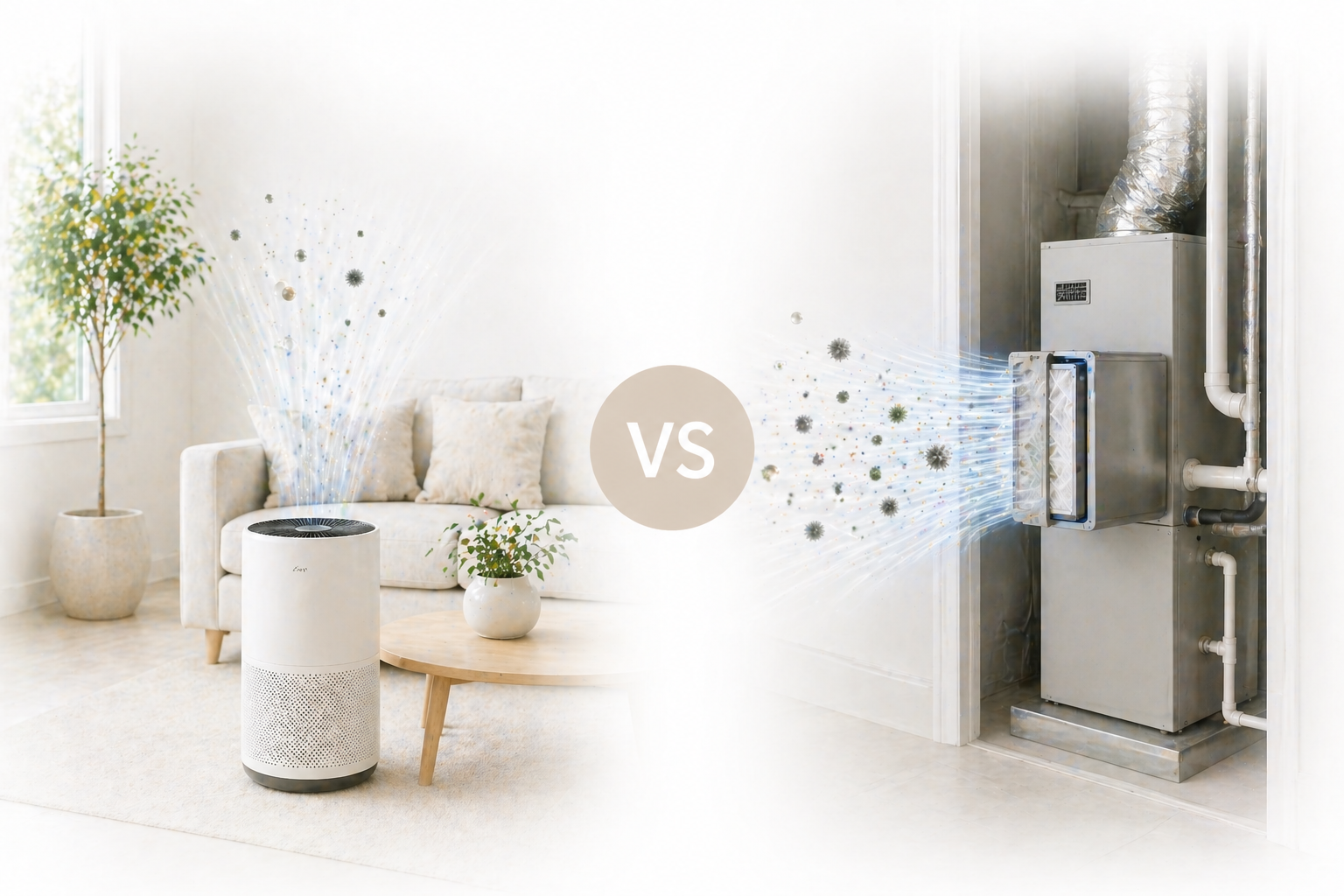
What a Consumer Air Purifier Is Designed to Do
A consumer air purifier is a standalone appliance designed to filter the air in a single room. It draws room air through a filter — typically a HEPA filter, sometimes combined with an activated carbon layer — and returns filtered air to the room. The primary variables that determine its effectiveness are the CADR rating (Clean Air Delivery Rate), which measures how quickly the unit delivers clean air at a given particle size, and the room size the unit is rated for.
For what they are designed to do, quality consumer units can be genuinely effective. A properly sized HEPA air purifier in a bedroom can meaningfully reduce the concentration of airborne particles — dust mite debris, pollen, pet dander, mold spores — in that room. For someone with allergies who spends eight hours a night in that room, a well-chosen unit placed correctly can produce a measurable improvement in their exposure during sleeping hours.
The limitations of consumer air purifiers are not flaws in the products — they are the natural boundaries of what a single-room appliance can accomplish in a whole-home context.
The Limitations of Consumer Air Purifiers
Coverage is local, not whole-property. A unit rated for 400 square feet cleans the air in 400 square feet — the room it is in, when the door is closed, under conditions where room air is circulating through the unit. The rest of the home receives no benefit from that unit. A three-bedroom, two-bath Florida home with an open floor plan requires a fundamentally different approach than a single unit in the corner of the living room can provide.
Sizing is frequently wrong. Consumer air purifiers are sold by room size recommendations, but those recommendations are typically calculated under ideal conditions — a square room with standard ceiling height, no furniture obstructing airflow, and the unit running at its highest fan setting continuously. Real rooms have furniture, irregular shapes, open doorways, and varying ceiling heights. Units are also frequently undersized because buyers select based on price point rather than the CADR rating required for the actual room volume. An undersized unit running at low speed may be cycling room air at a rate far below what is needed to achieve meaningful particle reduction.
HEPA filtration does not address gaseous contaminants. True HEPA filters capture particles — biological matter, dust, pollen — but do not adsorb VOCs, formaldehyde, CO₂, or other gaseous pollutants. A unit without an activated carbon stage provides no benefit for chemical contaminants regardless of its particle filtration rating. Many consumer units include a thin carbon layer that provides limited adsorption capacity and saturates relatively quickly, after which it provides no ongoing VOC reduction.
The source is not addressed. A consumer air purifier running in a room with active mold growth inside the wall reduces the airborne spore concentration in that room to some extent. It does not address the colony producing those spores. As long as the source remains, the purifier is managing a symptom rather than resolving the problem. This distinction becomes particularly important when the purpose of air purification is to support health outcomes in occupants who are already affected — a purifier that partially reduces exposure while the source continues to produce contaminants is a limited intervention.
Maintenance is inconsistent. Consumer units require filter replacement on a schedule — typically every six to twelve months for HEPA filters, more frequently for carbon stages. In practice, filters are frequently replaced later than recommended or not at all. A HEPA filter that has exceeded its service life does not fail catastrophically — it continues to move air, it may continue to capture some particles, but its efficiency drops progressively and it can begin releasing captured particles back into the air stream. Without a professional maintenance schedule, the performance of consumer units degrades in ways that are not visible to the user.
What Professional Air Purification Involves
Professional air purification is not a single product — it is a system specification built around the specific property, its air volume, its contaminant profile, and its mechanical infrastructure. The process begins with assessment, not with a product recommendation.
Assessment-driven specification means that the technology selected, the system configuration, and the installation locations are determined by what the IAQ assessment found — not by what is available at a price point. A property with elevated VOC concentrations from recent renovation requires a different primary technology than a property with HVAC-distributed biological contamination from a mold event. A commercial space with high occupancy and CO₂ accumulation requires a different ventilation and filtration approach than a single-family residence with an immunocompromised occupant. Professional specification matches the solution to the documented problem.
CADR sizing against actual air volume — rather than manufacturer room size estimates — ensures that the installed system achieves the air changes per hour required to maintain meaningful contaminant reduction in the treated space under actual occupancy and use conditions. The ASHRAE Standard 62.1 provides the engineering basis for ventilation and filtration sizing that professional specification references. Consumer products are not designed to be specified against these standards.
HVAC integration is available as a professional installation option that consumer products do not offer. UV-C germicidal systems installed in the air handler treat all air passing through the mechanical system — providing whole-property biological contaminant management rather than room-by-room particle capture. Whole-home electronic air cleaners and media filters installed in the return air stream filter all circulating air at a level of efficiency that standalone units cannot match for whole-property coverage.
Technology combinations address multiple contaminant categories simultaneously. A professionally specified system for a property with both biological and chemical contaminant concerns may combine HEPA filtration for particle capture, activated carbon media for VOC adsorption, and UV-C treatment for biological neutralization — each component addressing a different part of the contaminant profile identified in the assessment.
Post-installation verification confirms that the installed system is achieving the expected contaminant reduction through follow-up air quality measurement — something consumer products do not provide and most purchasers never pursue.
When a Consumer Air Purifier Is Sufficient
This is the honest part of the comparison: for certain situations, a well-chosen consumer air purifier is a reasonable and proportionate response.
A consumer HEPA unit is appropriate when the goal is to reduce particle exposure in a single room for a specific occupant — a bedroom for someone with allergies, a nursery, a home office where a person spends most of their working day. When the room size is accurately matched to the unit’s CADR rating, the filter is replaced on schedule, and the unit is running continuously rather than intermittently, a quality consumer purifier can produce meaningful particle reduction in that space.
Consumer units become insufficient when the goal is whole-home air quality improvement, when the contaminant profile includes gaseous pollutants that HEPA filtration does not address, when an active contamination source is present, or when the health needs of occupants require a documented, verifiable level of air quality management rather than an approximation.
The Right Question to Ask
The question is not “should I buy an air purifier?” — it is “what does my indoor environment actually contain, and what level of intervention does that require?”
A consumer unit purchased without knowing what contaminants are present in the home is a guess. It may be a useful guess, or it may be addressing the wrong problem with the wrong technology at the wrong scale. A professionally specified system built from IAQ assessment findings is a documented response to a measured problem — with post-installation verification that confirms it is working.
If you are considering air purification for your home or commercial property and want to make sure the solution matches the actual situation, FPT Environmental provides IAQ assessment and professional air purification solutions throughout South and Central Florida. Contact us here.
FPT Environmental LLC provides indoor air quality testing, professional air purification solutions, mold remediation, and environmental restoration services throughout South and Central Florida. This article is intended for general informational purposes and does not constitute medical advice.
Quick Links
About Us
Academy
Services
Products
Financing
Resources
Academy Policy
Privacy Policy
Refund Policy
Let’s Stay Connected
Join our mailing list for expert insights, seasonal property protection strategies, and updates on the latest in indoor air quality technology directly from FPT Environmental.