Does Running Your AC Improve or Worsen Your Indoor Air Quality?
In Florida, the air conditioning runs almost every day of the year. Whether it is helping or hurting your indoor air quality depends entirely on what is happening inside the system.
Air conditioning is not optional in Florida. For most of the year, it is the primary mechanism that makes indoor spaces livable — controlling temperature, reducing humidity, and providing the filtered air circulation that keeps indoor environments comfortable. Most people assume that because the AC is filtering the air, it is improving it.
That assumption is correct when the system is clean, properly maintained, and operating as designed. It becomes incorrect — sometimes significantly so — when the system itself has become a source of contamination. And in Florida’s climate, the conditions that turn an HVAC system from an asset into a liability are not unusual. They are predictable.
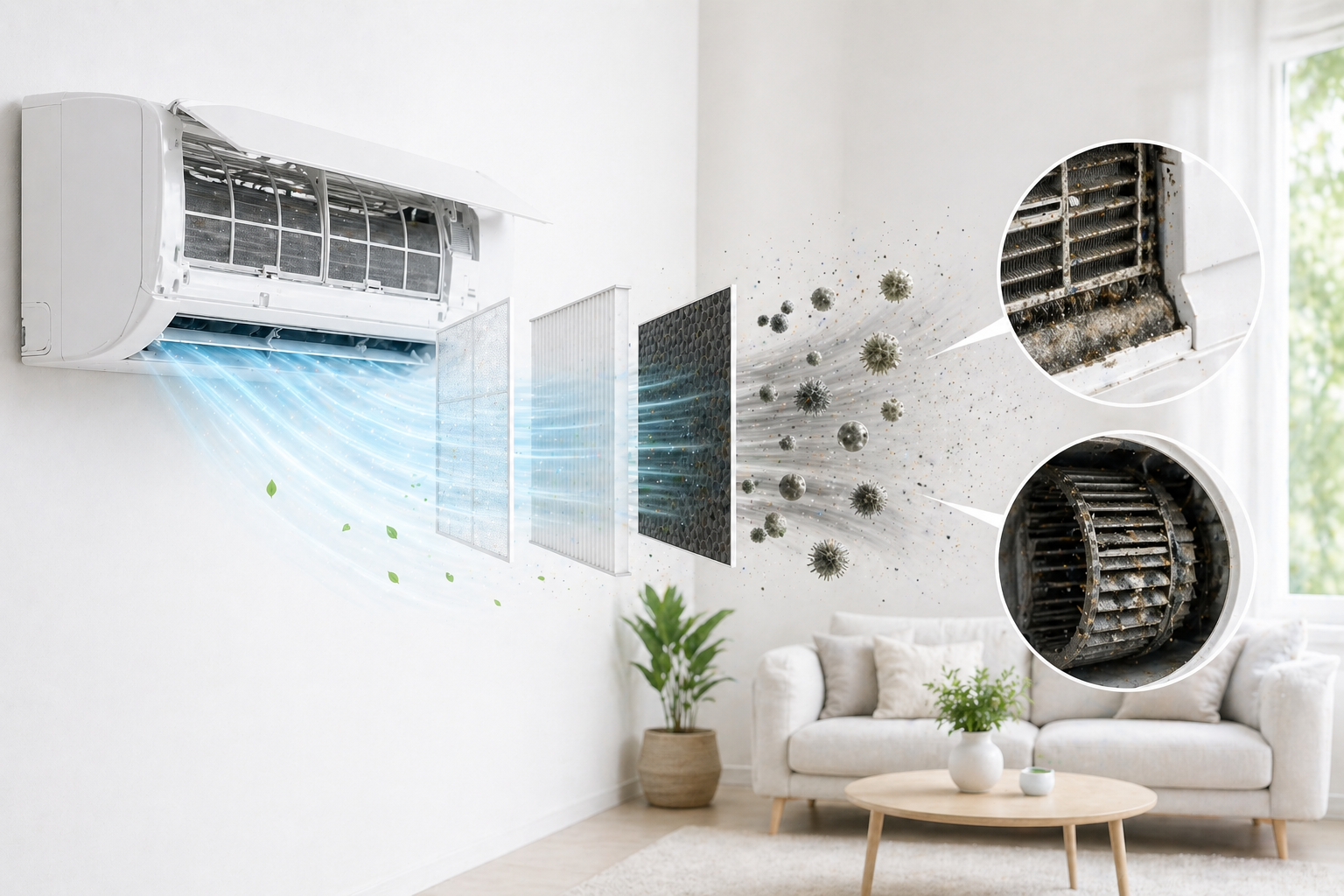
How an AC System Is Supposed to Affect Air Quality
A properly functioning air conditioning system improves indoor air quality through three mechanisms.
Filtration — Air passing through the system is drawn across a filter that captures particles — dust, pollen, pet dander, and larger mold spores — before the air is conditioned and returned to the living space. The effectiveness of this filtration depends on the filter’s MERV rating, how regularly it is replaced, and whether air is bypassing the filter through gaps in the system.
Humidity control — The cooling process removes moisture from the air through condensation on the evaporator coil. In Florida, where outdoor relative humidity regularly exceeds 80 percent, the dehumidification function of air conditioning is as important as the temperature control. Maintaining indoor relative humidity below 60 percent — and ideally between 40 and 50 percent — is one of the most effective ways to suppress the moisture conditions that support mold and biological growth.
Air circulation — Continuous air movement through the system reduces stagnant zones where contaminants accumulate and provides consistent distribution of filtered, conditioned air throughout the served space.
These benefits are real. In a well-maintained system, running the AC does improve indoor air quality relative to an unconditioned, unventilated space.
Where the System Becomes a Problem
The same characteristics that make an HVAC system effective at improving air quality make it effective at distributing whatever it contains — including contaminants — throughout the building. When the system develops biological growth, accumulates debris, or experiences moisture management failures, it becomes a distribution network for the problem rather than a solution to it.
The evaporator coil is the most critical component for IAQ purposes. It is perpetually cold and wet — the exact conditions that support mold and bacterial growth. When the drain pan beneath the coil does not drain completely, standing water accumulates and biological growth establishes on both the pan surface and the coil itself. Air passing over a contaminated coil picks up biological particles and distributes them through every supply register in the system.
The drain line — the pipe that removes condensate from the drain pan — clogs with algae, mold, and debris in Florida’s humidity with enough regularity that it is considered routine maintenance rather than an unusual event. A clogged drain line causes the pan to overflow, introducing water into the air handler cabinet and potentially into the surrounding structure.
Ductwork accumulates dust, biological debris, and — in systems with any history of moisture intrusion or condensation — mold growth on duct surfaces. Supply ducts that pass through unconditioned spaces like attics or crawl spaces are particularly vulnerable, as temperature differentials between the conditioned air inside the duct and the hot attic air outside can produce condensation on duct surfaces when insulation is inadequate or compromised.
The air filter, when not replaced regularly, becomes saturated with captured particles to the point where airflow resistance increases significantly. At that point, air begins to bypass the filter entirely through gaps around the filter frame — meaning the system is moving air without filtering it.
According to the EPA’s guidance on HVAC systems and IAQ, poorly maintained HVAC systems are one of the most common contributors to indoor air quality problems in both residential and commercial buildings.
The Signs That Your AC May Be Hurting Your Air Quality
Because HVAC-related IAQ problems develop gradually and the distribution of contaminants is invisible, they are frequently attributed to other causes before the system is identified as the source. These are the indicators that the system warrants investigation:
- A musty or stale odor that appears specifically when the system runs — and disappears or diminishes when the system is off. This is the most reliable single indicator of biological growth in the air handler, coil, or ductwork.
- Allergy or respiratory symptoms that are worse indoors — particularly if they worsen when the system is running and improve when windows are open or when the occupant leaves the building.
- Visible discoloration around supply registers — dark staining on the ceiling or wall around supply vents indicates that the system is distributing particulates, biological material, or both.
- Visible debris or growth on return grilles — the return air grilles are where room air enters the system. Heavy dust accumulation or dark staining on return grilles indicates what the system has been processing.
- Increased dust accumulation on surfaces — faster than normal dust accumulation on horizontal surfaces can indicate a system distributing fine particles more than it is capturing them.
The American Society of Heating, Refrigerating and Air-Conditioning Engineers (ASHRAE) publishes standards for HVAC system maintenance specifically because system condition has a direct, documented relationship with the IAQ of the spaces the system serves.
The Humidity Variable
Humidity management is where Florida HVAC systems face their most significant and least discussed challenge. A system that is oversized for its served space — which is common in Florida due to aggressive sizing practices — will cool the space to the set temperature quickly but run for short cycles. Short cycles do not allow adequate time for the dehumidification process to occur. The result is a space that is at the right temperature but at relative humidity levels that support biological growth — typically above 60 percent.
This phenomenon, sometimes called “cold and clammy,” is the hidden mechanism behind a significant number of Florida mold problems that occur without any visible water intrusion event. The moisture source is not a leak — it is an air conditioning system that is removing heat effectively but not removing humidity adequately.
The Florida Solar Energy Center has documented oversizing and short cycling as a primary driver of elevated indoor humidity in Florida homes, with direct implications for mold risk and IAQ.
If your home maintains relative humidity consistently above 60 percent despite running the air conditioning, the system’s capacity, configuration, or operation may be contributing to the conditions that support biological growth.
What to Do About It
The answer to whether your AC is helping or hurting your air quality is not found by looking at the thermostat. It is found by looking at — and testing — the system itself.
Filter maintenance is the baseline. Filters should be replaced on a schedule appropriate to the filter type, the occupancy load, and the particulate environment — not simply when they look dirty, which is often long after they have already begun to restrict airflow.
Annual coil and drain pan inspection and cleaning is standard preventive maintenance that is frequently skipped in practice. In Florida’s climate, annual is the minimum — properties with known IAQ concerns or high occupancy may benefit from more frequent inspection.
Duct assessment — particularly in systems with a history of moisture issues or in older buildings — should include inspection for biological growth and debris accumulation that filter replacement alone will not address.
Professional IAQ assessment, which includes real-time particle counts, CO₂ measurement, and where indicated air sampling for biological contaminants, provides an objective picture of what the system is currently contributing to the indoor environment.
Where biological growth is identified in HVAC components, professional remediation of the affected components — coil cleaning, drain pan treatment, duct sanitization — addresses the source. Air purification systems integrated with the HVAC provide ongoing filtration that reduces the impact of whatever the system inevitably accumulates over time.
If you are concerned about what your HVAC system may be contributing to your indoor air quality, FPT Environmental provides professional IAQ assessment services throughout South and Central Florida. Contact us here.
FPT Environmental LLC provides indoor air quality testing, HVAC-related IAQ assessment, mold remediation, and environmental restoration services throughout South and Central Florida. This article is intended for general informational purposes and does not constitute medical advice.
Quick Links
About Us
Academy
Services
Products
Financing
Resources
Academy Policy
Privacy Policy
Refund Policy
Let’s Stay Connected
Join our mailing list for expert insights, seasonal property protection strategies, and updates on the latest in indoor air quality technology directly from FPT Environmental.