Can You Have Bad Air Quality If Your Home Looks and Smells Clean?
A clean home and a healthy indoor environment are not the same thing. The most significant air quality problems are invisible, odorless, and entirely undetectable without the right instruments.
The assumption is almost universal: if a home looks clean and does not smell like anything unusual, the air must be fine. It is a reasonable inference — visible mold, dust accumulation, and musty odors are all genuine indicators of air quality problems, and their absence feels like reassurance.
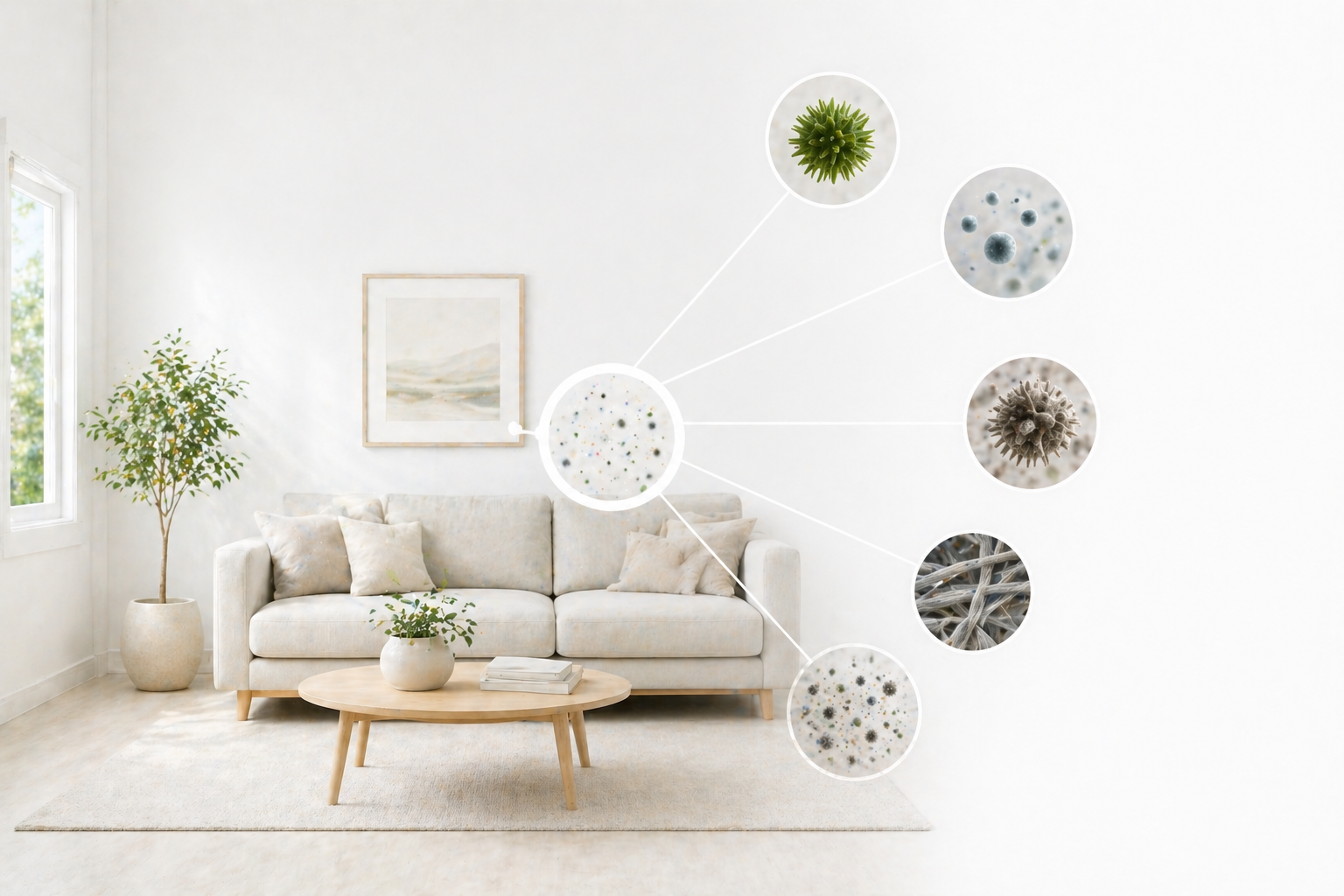
The problem is that many of the most significant contributors to poor indoor air quality produce no visible signs and no detectable odor at the concentrations at which they affect health. A home can be spotless, freshly renovated, and completely odor-free while containing airborne contaminants at levels that have measurable effects on the people living in it.
Understanding why requires understanding what indoor air quality actually measures — and what regular cleaning does and does not address.
What Cleaning Does and Does Not Do for Air Quality
Regular cleaning removes surface dust, eliminates visible debris, and reduces the accumulation of particulates on horizontal surfaces. These are genuine contributions to a healthier indoor environment — surface dust contains allergens, biological debris, and accumulated chemical compounds that become airborne when disturbed.
What cleaning does not do is address contaminants that are not on surfaces. Volatile organic compounds off-gassing from building materials, formaldehyde releasing from composite wood furniture, carbon dioxide accumulating in a poorly ventilated space, and airborne biological particles from a mold colony inside a wall cavity — none of these are affected by mopping floors or wiping countertops.
Cleaning also does not improve ventilation, which is one of the primary mechanisms through which indoor contaminants are diluted and removed. A meticulously cleaned home with inadequate fresh air exchange accumulates the same contaminants as an uncleaned one — it simply has fewer surface particles alongside them.
The EPA’s research on indoor air quality makes this distinction clearly: the sources of most significant indoor air pollutants are the building materials, mechanical systems, and occupant activities that produce contaminants continuously — not the surface dust that cleaning addresses.
Contaminants That Produce No Visible Signs or Odor
Several of the most common and most studied indoor air contaminants are undetectable by sight or smell at concentrations that affect health.
Formaldehyde is colorless and odorless at low concentrations. It off-gasses continuously from composite wood products — particleboard, MDF, plywood — used in cabinetry, shelving, and furniture, as well as from certain flooring products and insulation. The National Cancer Institute classifies it as a known human carcinogen. At the concentrations typically found in homes with significant composite wood content, it produces no perceptible odor and no visible indication of its presence.
Carbon dioxide accumulates in any occupied, insufficiently ventilated space as a natural byproduct of respiration. It is colorless, odorless, and tasteless. Elevated CO₂ levels — which can develop in well-sealed, energy-efficient homes with inadequate mechanical ventilation — are directly associated with reduced cognitive performance, increased fatigue, and difficulty concentrating. The ASHRAE Standard 62.1 establishes ventilation requirements specifically to prevent CO₂ accumulation in occupied spaces — because the effects are real and measurable at concentrations that occupants cannot detect without instrumentation.
Fine particulate matter (PM2.5) — particles small enough to penetrate deep into the respiratory tract — is invisible to the naked eye and produces no odor. Sources include HVAC systems distributing fine debris, combustion from gas appliances, and outdoor infiltration through the building envelope. The American Lung Association identifies fine particle exposure as a significant respiratory health concern with effects on both short-term symptoms and long-term lung health.
Mold inside building assemblies — growing within wall cavities, inside HVAC components, or beneath flooring — frequently produces no visible sign and no perceptible odor in the occupied spaces of a building, particularly in early stages or in locations where air circulation limits the concentration of spores reaching living areas. The growth is real, the spore production is ongoing, but the occupied space gives no indication of it.
The Freshly Renovated or New Construction Scenario
One of the highest-risk scenarios for poor IAQ in a visually clean home is a newly renovated or recently built space. New construction and renovation introduce significant loads of VOCs from fresh paint, flooring adhesives, new cabinetry, sealants, and furnishings — all of which are off-gassing at their highest rates immediately after installation.
A brand new home or recently renovated space typically smells “new” — a scent that most people associate with freshness and cleanliness. That smell is VOCs. The concentration of off-gassing compounds in a newly finished space is typically at its highest point in the days and weeks immediately following completion, before materials have had time to cure and before ventilation has had the opportunity to dilute and carry away the accumulated load.
According to the EPA, VOC concentrations in newly built or renovated spaces can be significantly elevated compared to established buildings — and the occupants moving in have no reason to suspect a problem because the space looks and smells exactly as expected.
Cleaning Products as a Source of Contaminants
There is an additional layer of irony in the clean-home assumption: the products used to achieve the clean appearance can themselves be contributors to poor indoor air quality. Many conventional cleaning products — surface sprays, glass cleaners, floor polishes, air fresheners — contain VOCs including glycol ethers, terpenes, and synthetic fragrance compounds that off-gas into the indoor environment during and after use.
Air fresheners in particular are a relevant example. They do not improve air quality — they introduce fragrance compounds into the air to produce a perception of cleanliness. The Environmental Working Group (EWG) has documented that many common air fresheners and cleaning products contain compounds that are classified as respiratory irritants or endocrine disruptors at levels well above their detection threshold by smell.
A home that smells strongly of cleaning products or air freshener is not necessarily a home with better air quality — it may simply be a home with a different contaminant profile than one that smells like nothing.
The Symptom Pattern That Points to the Indoor Environment
Because clean-home IAQ problems produce no visible evidence, the primary indicator is often the symptom pattern of occupants. The pattern that consistently points to the indoor environment rather than other causes is the correlation between time in the building and symptom occurrence.
Symptoms that are worse at home and improve when away — regardless of whether the home looks clean or not — warrant environmental investigation. These include:
- Persistent fatigue that improves on weekends away or during travel
- Morning headaches that clear up after leaving the home for the day
- Respiratory or allergy symptoms that are consistently better outdoors
- Difficulty concentrating that correlates with time spent in a specific room or space
- Sleep quality that is noticeably better in other locations
The American College of Occupational and Environmental Medicine (ACOEM) recognizes this pattern — building-related symptoms that resolve when the occupant leaves the building — as a clinical indicator warranting professional environmental assessment regardless of the apparent cleanliness of the space.
What It Takes to Actually Know
The only way to determine the actual quality of indoor air is to measure it. Professional IAQ assessment using calibrated instrumentation — particle counters, CO₂ meters, VOC detectors, and laboratory-analyzed air samples — produces an objective profile of what the indoor environment contains, independent of what it looks or smells like.
This assessment does not require a visible problem to justify it. Property owners who want to establish a baseline, who have unexplained occupant symptoms, who have recently renovated or moved into a new space, or who simply want to know what they are breathing — all have legitimate reasons to commission a professional assessment.
A clean-looking, clean-smelling home that tests within acceptable ranges on all measured parameters is genuinely a healthier indoor environment. A clean-looking, clean-smelling home that has never been assessed may or may not be — and without measurement, the difference is not knowable.
If you want to know what is actually in the air in your home, FPT Environmental provides professional indoor air quality testing throughout South and Central Florida. Contact us here.
FPT Environmental LLC provides indoor air quality testing, advanced IAQ assessment, air purification solutions, and environmental restoration services throughout South and Central Florida. This article is intended for general informational purposes and does not constitute medical advice.

Quick Links
About Us
Academy
Services
Products
Financing
Resources
Academy Policy
Privacy Policy
Refund Policy
Let’s Stay Connected
Join our mailing list for expert insights, seasonal property protection strategies, and updates on the latest in indoor air quality technology directly from FPT Environmental.