How Do You Know If Your HVAC Is Making You Sick?
Your air conditioning system runs every day, reaches every room, and touches every breath of air you take indoors. When it develops a problem, the whole home knows it — even if no one can identify the source.
In Florida, the HVAC system is the most used appliance in the home by a significant margin. It runs for the majority of the year, conditions virtually all the air that occupants breathe indoors, and connects every room in the building through a shared air supply. This makes it indispensable for comfort — and uniquely capable of affecting the health of every person in the home when something goes wrong inside it.
HVAC-related health complaints are among the most commonly misdiagnosed indoor air quality problems precisely because the symptoms they produce are non-specific. Headaches, fatigue, respiratory irritation, and worsening allergies are attributed to dozens of other causes before the air conditioning system is considered. By the time someone looks inside the air handler or has the ductwork assessed, the problem has often been present — and affecting occupants — for months.
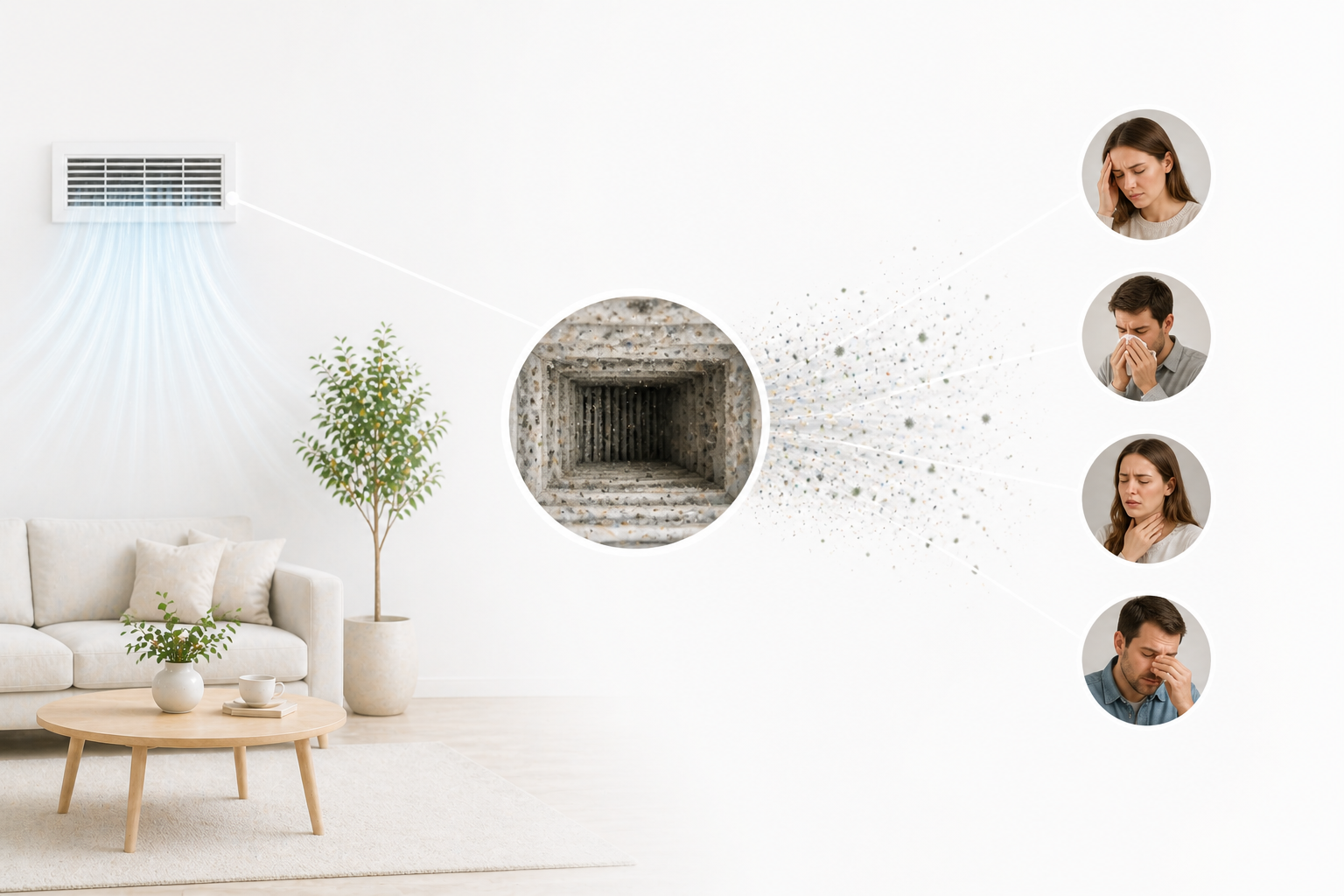
How the HVAC System Affects What You Breathe
Understanding why the HVAC system has such a significant influence on indoor air quality requires understanding what it actually does to the air it processes.
Every cubic foot of air in your home passes through the HVAC system repeatedly throughout the day. The system draws room air through return grilles, passes it across the evaporator coil where it is cooled and dehumidified, filters it through the installed filter media, and returns it through supply registers to the living spaces. This cycle repeats continuously while the system operates.
What this means in practice is that the HVAC system is not just a heating and cooling device — it is the primary air processing system for the entire home. Whatever is present inside it — biological growth on the coil, debris accumulated in the ductwork, contamination in the drain pan — is introduced into the air supply on every cycle. The system that is supposed to be improving the air can become the mechanism through which problems are distributed throughout the building.
The Most Common HVAC-Related IAQ Problems
Mold on the evaporator coil and in the drain pan
The evaporator coil is perpetually cold and wet — the exact combination of conditions that promotes biological growth. Condensate forms on the coil surface during every cooling cycle, drains into the pan below, and exits through the condensate drain line. When the drain line is partially or fully blocked — a common occurrence in Florida’s humidity, where algae growth in drain lines is routine — water backs up in the pan and stands. Standing water in a warm, enclosed space with organic debris is an ideal mold and bacterial growth environment.
Growth on the coil and in the drain pan is introduced directly into the supply air stream. Every time the system runs, biological particles from contaminated components are distributed to every room the system serves. The EPA’s guidance on HVAC systems identifies the evaporator coil and drain pan as primary biological growth sites in residential systems.
Contaminated or deteriorated ductwork
Ductwork accumulates dust, biological debris, and in systems with any history of moisture intrusion, mold growth on duct surfaces. Supply ducts routed through unconditioned attic spaces are particularly vulnerable — in Florida’s summer attic temperatures, temperature differentials between the cold conditioned air inside the duct and the hot surrounding air can produce condensation on duct surfaces when duct insulation is inadequate or damaged. That condensation provides the moisture that sustains biological growth inside the duct.
Flex duct — the corrugated, insulated ductwork commonly used in Florida residential construction — is particularly susceptible to debris accumulation in the corrugations and to moisture intrusion when the outer insulation is compromised.
Filter bypass
A clogged or improperly seated air filter does not simply reduce filtration efficiency — it causes air to bypass the filter entirely through the path of least resistance. Air that bypasses the filter enters the system unfiltered, carrying whatever particles it contains directly to the supply air stream. Improper filter installation — a filter that does not fully seal against the filter frame — produces the same result at any level of filter cleanliness.
Oversized systems and short cycling
Systems that are oversized for the space they serve cool quickly and run short cycles. Short cycles do not allow adequate time for dehumidification. The result is indoor relative humidity levels above 60 percent — the threshold above which biological growth is actively supported throughout the building — despite the air conditioning running regularly.
The Symptoms That Point to the HVAC System
The symptoms associated with HVAC-related IAQ problems overlap with respiratory illness, seasonal allergies, and other common conditions. What distinguishes HVAC-related symptoms is their pattern — specifically, their relationship to system operation and time spent in the building.
The pattern that most reliably points to the HVAC system includes:
- A musty, stale, or metallic odor that appears specifically when the system turns on and diminishes when the system is off
- Symptoms that are worse indoors and better outdoors, or better in rooms where the system does not supply air directly
- Symptoms that improve noticeably on days when windows are open or when the occupant spends extended time away from home
- Allergy or asthma symptoms that have worsened without a clear external explanation and that do not respond normally to usual treatments
- Eye, nose, and throat irritation that is persistent indoors but clears up relatively quickly when the person leaves the building
- Fatigue or difficulty concentrating that correlates with time spent in the home, particularly in rooms closest to supply registers
The American College of Occupational and Environmental Medicine (ACOEM) recognizes building-related illness — where symptoms are directly linked to time spent in a specific building — as a documented clinical condition. The HVAC system is one of the most common building-related illness sources identified in both residential and commercial settings.
What Visual Inspection Does and Does Not Tell You
Many homeowners who suspect an HVAC problem look at the visible components — the filter, the return grilles, the supply registers — and form a conclusion based on what they see. This is a reasonable starting point and not without value. A heavily soiled filter, visible dark staining on supply grilles, or obvious debris on return grilles are all meaningful findings.
What visual inspection cannot assess is the condition of the evaporator coil inside the air handler cabinet, the interior surfaces of ductwork beyond the first few inches of a register opening, the drain pan beneath the coil, or the biological load the system is actually delivering to the air supply.
These areas require professional inspection with appropriate access and, for a complete picture, air sampling in the supply air stream or downstream of the air handler.
Professional HVAC-related IAQ assessment combines visual inspection of accessible components with real-time instrumentation — particle counters, biological air sampling, and VOC detection — to produce an objective measurement of what the system is contributing to the indoor environment. The difference between “the filter looks dirty” and “the supply air contains elevated mold spore concentrations at three times outdoor baseline levels” is the difference between an impression and a documented finding.
What to Do If You Suspect Your HVAC Is the Source
If the symptom pattern described above applies to your household — particularly if symptoms correlate with system operation and improve when away from home — these are the practical steps worth taking:
Check and replace the filter — confirm the filter is properly seated with no gaps around the frame, and replace it if it has been more than three months since the last replacement. This is the baseline step, not the solution.
Inspect the condensate drain line — a simple test is to pour a cup of water into the drain pan and observe whether it drains promptly. Standing water or slow drainage indicates a blockage that needs clearing.
Note whether the odor is specific to system operation — if a musty smell appears when the system turns on and diminishes when it is off, the source is almost certainly inside the air handler or ductwork rather than in the living space.
Commission a professional HVAC IAQ assessment — particularly if symptoms have been persistent, if basic maintenance has not resolved the issue, or if any occupant has respiratory conditions that make air quality a health-critical concern. Professional assessment determines whether the system is the source, identifies what is present, and informs the appropriate remediation response.
Where biological growth is confirmed in HVAC components, professional remediation of affected areas — coil cleaning, drain pan treatment, duct sanitization where indicated — addresses the source rather than managing its downstream effects.
If you have symptoms or concerns that suggest your HVAC system may be affecting your indoor air quality, FPT Environmental provides professional IAQ assessment and HVAC-related air quality services throughout South and Central Florida. Contact us here.
FPT Environmental LLC provides indoor air quality testing, advanced IAQ assessment, mold remediation, and environmental restoration services throughout South and Central Florida. This article is intended for general informational purposes and does not constitute medical advice.

Quick Links
About Us
Academy
Services
Products
Financing
Resources
Academy Policy
Privacy Policy
Refund Policy
Let’s Stay Connected
Join our mailing list for expert insights, seasonal property protection strategies, and updates on the latest in indoor air quality technology directly from FPT Environmental.