What Is Indoor Air Quality and Why Does It Matter More Than Outdoor Air?
Most people assume outdoor air is the pollution problem. The air inside your home may be telling a different story — and you are breathing it for up to 90 percent of your day.
When people think about air pollution, they picture outdoor smog, traffic exhaust, or industrial emissions. Indoor air rarely comes to mind. Most homes feel clean, especially when they look clean — there is no visible haze, no obvious odor, no apparent reason for concern.
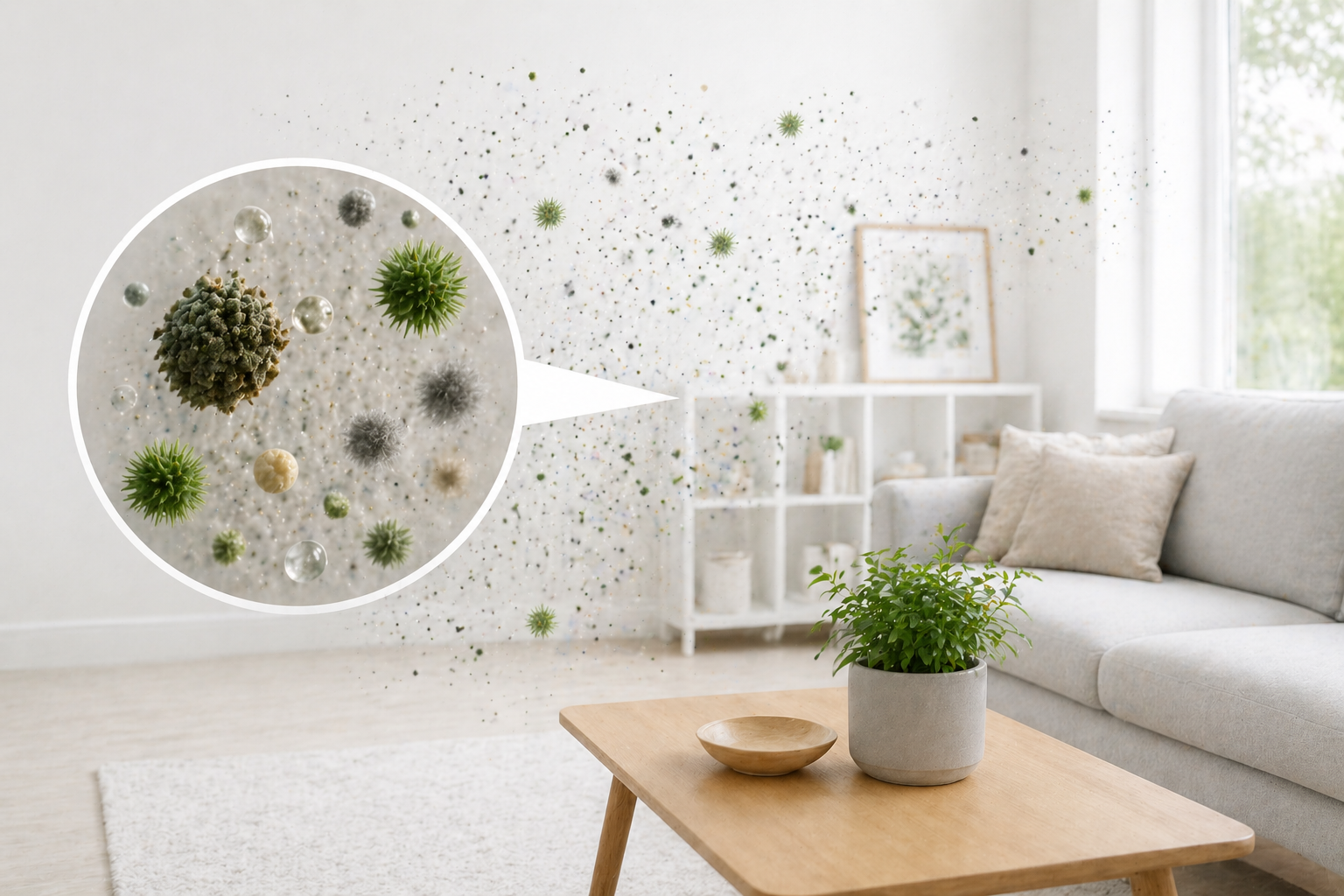
But indoor air quality is not determined by how a space looks or smells. It is determined by what the air contains — and the air inside most homes contains a combination of biological, chemical, and particulate contaminants that are not visible to the naked eye and are not removed by regular cleaning.
Understanding what indoor air quality actually means, and why it matters, is the starting point for making informed decisions about the environment you and your family live in every day.
What Indoor Air Quality Actually Measures
Indoor air quality — commonly abbreviated as IAQ — refers to the condition of the air within and around a building as it relates to the health and comfort of its occupants. It is not a single measurement but a profile of multiple factors assessed together:
- Biological contaminants — mold spores, bacteria, dust mite debris, pet dander, and other particles of biological origin
- Chemical contaminants — volatile organic compounds (VOCs) off-gassing from building materials, furnishings, adhesives, and cleaning products; formaldehyde from composite wood products; and combustion byproducts from gas appliances
- Particulate matter — fine and ultrafine particles (PM2.5 and PM10) from HVAC systems, outdoor infiltration, cooking, and combustion sources
- Carbon dioxide — produced by occupants breathing; elevated levels in poorly ventilated spaces directly affect cognitive function and alertness
- Temperature and relative humidity — both independently affect comfort and health, and humidity in particular determines whether biological contaminants can establish and persist in the indoor environment
Each of these factors can be within acceptable ranges or significantly elevated depending on the specific building, its construction, its mechanical systems, and how it is used. A home that scores well on one factor may have significant issues with another. This is why meaningful IAQ assessment measures the full profile rather than a single indicator.
Why Indoor Air Is Often More Polluted Than Outdoor Air
The statistic cited most frequently in indoor air quality research — that indoor air can be two to five times more polluted than outdoor air, and in some cases significantly more — comes from the U.S. Environmental Protection Agency, which has studied IAQ extensively and considers it one of the top five environmental risks to public health.
The reasons indoor air accumulates contaminants more readily than outdoor air come down to concentration and ventilation.
Outdoor air, for all its pollution sources, has essentially unlimited volume. Contaminants disperse. Indoor air is contained within a finite space, and the contaminants generated or introduced into that space — off-gassing from furniture, spores from a mold colony inside a wall cavity, combustion byproducts from a gas stove, particles stirred up by foot traffic — accumulate rather than disperse. Modern energy-efficient construction, while beneficial for thermal performance and utility costs, reduces the natural air infiltration that historically provided dilution of indoor contaminants. The same tight building envelope that keeps conditioned air in also keeps indoor pollutants in.
In Florida, this dynamic is compounded by the climate. High ambient humidity promotes biological growth. Warm temperatures year-round accelerate the rate at which building materials off-gas VOCs. Air conditioning systems run continuously for most of the year, and when those systems harbor mold growth or accumulate dust and biological material — as they frequently do in Florida’s humid conditions — they distribute whatever they contain through every room they serve.
The 90 Percent Factor
The EPA estimates that people in the United States spend approximately 90 percent of their time indoors. For many people — particularly those who work from home, have young children, or have health conditions that limit outdoor activity — that figure is higher.
This matters because exposure is a function of both concentration and duration. A brief exposure to a moderately elevated contaminant level carries different implications than continuous exposure to the same level across 16 or more hours per day, every day. The indoor environment is where most people accumulate the majority of their total air pollutant exposure — which means the quality of indoor air has a disproportionate influence on overall health outcomes compared to the outdoor air that receives most of the public attention.
The World Health Organization (WHO) recognizes indoor air pollution as a significant global health concern, with particular relevance for residential environments where occupants have sustained, daily exposure.
What Poor IAQ Actually Feels Like
Indoor air quality problems do not always announce themselves with obvious odors or visible contamination. Many of the most common symptoms of poor IAQ are non-specific — they overlap with other conditions and are easily attributed to other causes:
- Persistent fatigue or low energy that improves when away from the building
- Frequent headaches, particularly in the morning or after extended time indoors
- Irritation of the eyes, nose, or throat that clears up outdoors
- Worsening of existing respiratory conditions like asthma or allergies
- Difficulty concentrating or mental fogginess during the workday
- Recurring respiratory infections
The pattern that is diagnostically significant is not any one of these symptoms in isolation — it is the correlation between time spent in the building and symptom occurrence or severity. When symptoms are consistently worse at home and consistently better elsewhere, the indoor environment warrants investigation.
This pattern is recognized by the American College of Occupational and Environmental Medicine (ACOEM) as a key clinical indicator of building-related illness — health effects that are directly linked to time spent in a specific indoor environment.
Common Sources of IAQ Problems in Florida Homes
While IAQ problems occur in buildings everywhere, several sources are particularly prevalent in Florida’s climate and construction context:
Mold and biological growth — Florida’s persistently high humidity creates sustained pressure on building materials. Water intrusion events, HVAC condensation, and vapor infiltration through the building envelope all contribute to moisture conditions that support mold growth in wall cavities, attic spaces, and mechanical systems. Mold contributes biological particles and microbial VOCs to the indoor air continuously while active.
HVAC systems — Air handlers, evaporator coils, and ductwork in Florida’s humidity accumulate biological growth, dust, and debris that are distributed through supply air throughout the property. The HVAC system is both a potential source of IAQ problems and the primary distribution mechanism that spreads them.
VOC off-gassing — Building materials, adhesives, paints, flooring products, and furnishings release VOCs as they age and as temperature rises. Florida’s warm climate accelerates off-gassing rates year-round. New construction and recently renovated spaces typically carry the highest VOC loads, which decrease over time but may remain elevated for months.
Inadequate ventilation — Energy-efficient construction reduces natural infiltration without always providing adequate mechanical ventilation as a substitute. Spaces that are sealed against outdoor air without sufficient controlled ventilation accumulate CO₂ and indoor-generated contaminants that have no pathway out.
What IAQ Assessment Involves
Unlike a standard mold inspection, which focuses on biological contaminants, a comprehensive IAQ assessment measures the full profile — biological, chemical, and physical factors — to produce an accurate picture of what the indoor environment actually contains.
Professional IAQ assessment uses a combination of real-time instrumentation and laboratory-analyzed samples. Particle counters measure airborne particulate matter. CO₂ meters assess ventilation adequacy. VOC detectors identify off-gassing hotspots. Air samples submitted to an accredited laboratory identify mold species and concentrations. Where chemical contaminants are a concern, sorbent tube sampling identifies specific VOC compounds and quantifies their concentrations against established reference thresholds.
The result is a documented, objective profile of the indoor environment — not an impression or a visual assessment, but a measurement-based record of what is present and at what levels.
If you have concerns about the air quality in your home or commercial property, FPT Environmental provides professional IAQ assessment and air purification solutions throughout South and Central Florida. Contact us here.
FPT Environmental LLC provides indoor air quality testing, air purification solutions, mold remediation, and environmental restoration services throughout South and Central Florida. This article is intended for general informational purposes and does not constitute medical advice.

Quick Links
About Us
Academy
Services
Products
Financing
Resources
Academy Policy
Privacy Policy
Refund Policy
Let’s Stay Connected
Join our mailing list for expert insights, seasonal property protection strategies, and updates on the latest in indoor air quality technology directly from FPT Environmental.