Is Black Mold Really More Dangerous Than Other Types?
“Black mold” is one of the most searched terms in home health — and one of the most misunderstood. Here is what the science actually says, and why the color of mold is the wrong thing to focus on.
Few phrases in home health carry as much weight as “black mold.” It appears in news headlines, gets referenced in real estate disputes, and sends homeowners into immediate alarm when they find dark growth on a wall or ceiling. The fear is understandable — the idea that a specific type of mold is uniquely toxic has been circulating widely for decades.
The reality is more nuanced, and understanding it leads to a more useful way of thinking about mold risk than color alone ever could.
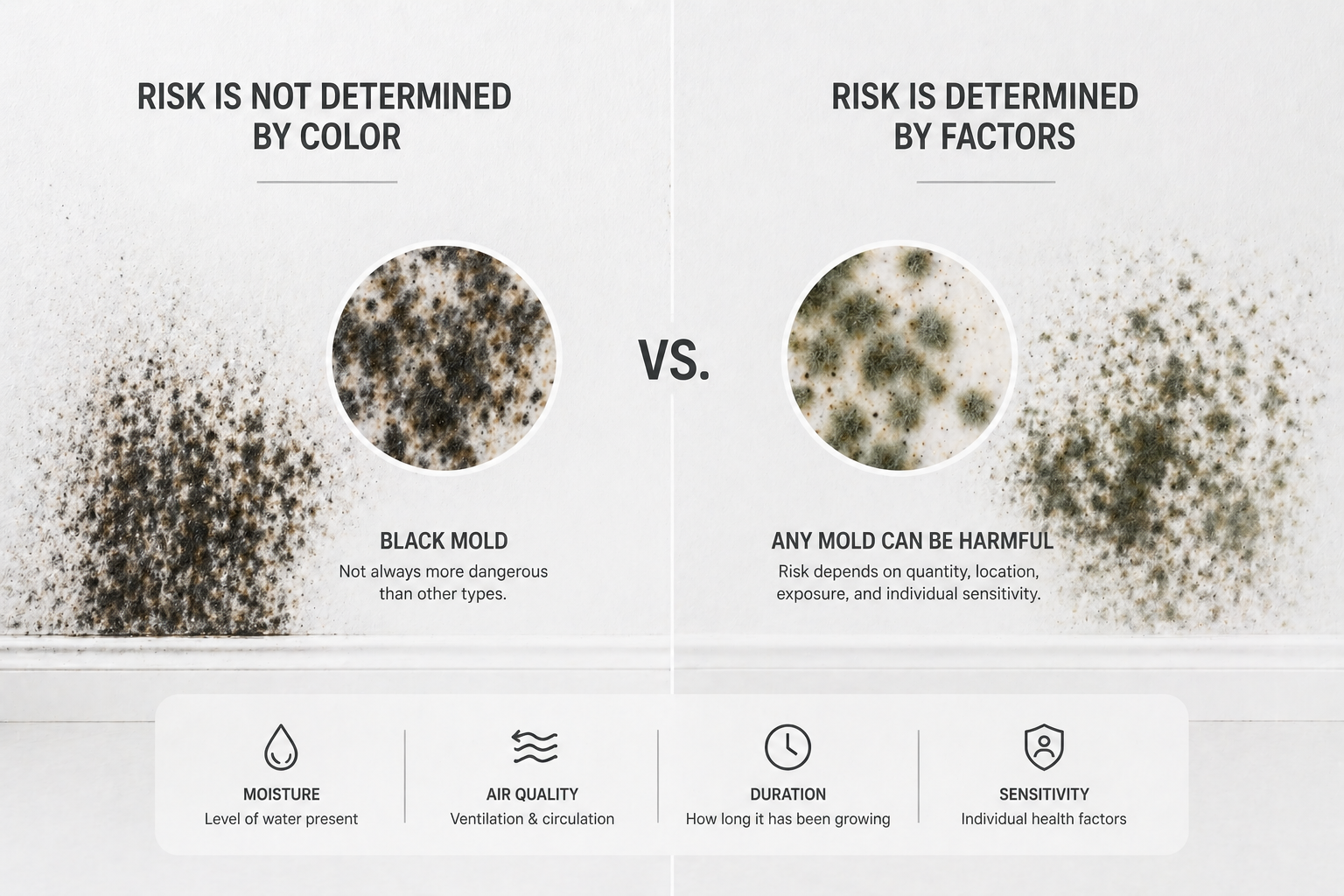
What People Mean by "Black Mold"
When most people say black mold, they are referring to Stachybotrys chartarum — a mold species that appears dark green to black, grows on cellulose-rich materials like drywall paper and wood, and requires sustained, significant moisture to establish. It became widely known in the 1990s following media coverage linking it to severe health outcomes in affected homes.
Stachybotrys is a real mold species with documented health significance. Certain strains produce mycotoxins — toxic chemical compounds that can cause adverse health effects at sufficient exposure levels. This part of the concern is scientifically grounded.
Where the popular understanding goes wrong is in the assumption that Stachybotrys is uniquely dangerous, that black-colored mold is always Stachybotrys, and that other mold species present less risk. None of these assumptions are accurate.
The Color Problem
Mold color is determined by the species, the growth stage, and the substrate it is growing on — not by its toxicity. Stachybotrys is typically dark green to black, but so are dozens of other mold species that produce no mycotoxins at all. Conversely, mold species that are white, gray, green, or brown can produce mycotoxins or cause significant health effects in sensitive individuals.
Aspergillus and Penicillium species — which are among the most common indoor molds and can appear in a wide range of colors including white, green, and blue-green — are responsible for a significant portion of mold-related health complaints and are known to produce mycotoxins in certain strains. Chaetomium, which produces mycotoxins, often appears white or gray before darkening. Fusarium, another mycotoxin producer, is often pink or white.
The CDC’s guidance on mold is explicit on this point: it is not possible to determine what type of mold you have based on color or appearance alone, and attempting to do so is not a substitute for professional testing.
Identifying mold species requires laboratory analysis of air or surface samples collected by a trained professional — not a visual assessment.
What Stachybotrys Actually Requires to Grow
One reason Stachybotrys receives disproportionate attention is that it is actually harder to establish than many other indoor mold species. It requires sustained, heavy moisture on cellulose-rich materials — not just elevated humidity or a brief wetting event. It grows more slowly than most common indoor molds and is typically found in situations involving prolonged, significant water damage rather than ordinary moisture accumulation.
This means two things. First, finding Stachybotrys in a building is a reliable indicator that a serious, sustained moisture problem has existed — it does not grow incidentally. Second, many of the mold problems that cause health complaints in buildings are caused by far more common species that establish much more easily and quickly under conditions that would never support Stachybotrys growth.
According to the EPA’s mold resources, the health effects associated with indoor mold exposure are not limited to any one species — they are associated with mold presence generally, particularly in individuals with respiratory conditions, allergies, or compromised immune systems.
A More Useful Framework: Exposure, Not Color
The question that matters for health risk assessment is not what color the mold is — it is how much exposure is occurring and who is being exposed.
Mold exposure in a building happens primarily through three pathways: inhalation of airborne spores, skin contact with contaminated surfaces, and in cases of significant mycotoxin contamination, ingestion of contaminated dust particles. Of these, inhalation is the most significant for most occupants.
The health significance of exposure depends on several factors:
- The concentration of spores or mycotoxins in the indoor air — a small surface colony in a well-ventilated area produces meaningfully different exposure than extensive growth inside an HVAC system that distributes spores throughout the building
- The duration of exposure — occasional brief exposure to elevated spore counts carries different implications than living or working in an affected building continuously
- The health status of the exposed individual — the American Academy of Allergy, Asthma and Immunology (AAAAI) documents that individuals with asthma, allergies, or compromised immune systems face significantly elevated risk from mold exposure compared to healthy adults
This framework — exposure level, duration, and individual susceptibility — is more clinically meaningful than species identification alone, and it explains why two people in the same building can have very different responses to the same mold condition.
Why Professional Testing Still Matters
The limitations of color-based identification make professional air and surface sampling more important, not less. Testing identifies what species are actually present, at what concentrations, and how those concentrations compare to outdoor baseline levels and established reference thresholds. It provides the objective data that neither visual inspection nor symptom reports alone can produce.
Where health concerns are significant — persistent respiratory symptoms, occupants with elevated sensitivity, or properties with documented moisture problems — mycotoxin testing goes a step further, identifying whether toxic compounds produced by mold have accumulated in building materials and dust independent of current airborne spore levels. This is particularly relevant because mycotoxins can persist in a building after the mold colony itself has been removed.
The absence of visible black mold is not reassurance that a mold problem does not exist or that occupant health is not being affected. And the presence of dark-colored mold is not automatically a crisis requiring emergency response — it is a finding that warrants professional assessment to determine what is actually present and what it means.
The Bottom Line
Stachybotrys chartarum is a real concern under the right conditions. It is not the only mold that matters, it cannot be identified by color, and focusing on it exclusively can lead to ignoring mold conditions that are more common, easier to establish, and equally capable of affecting occupant health.
The right response to finding any mold — regardless of color — is the same: do not disturb it, document it, and have it assessed by a professional who can identify what is present and determine the appropriate response based on actual findings rather than appearance.
If you have found mold in your property and want to know what you are actually dealing with, contact FPT Environmental. Professional air sampling and laboratory analysis gives you answers that a visual assessment never can.
FPT Environmental LLC provides mold testing, mold remediation, mycotoxin testing, indoor air quality assessment, and environmental restoration services throughout South and Central Florida. This article is intended for general informational purposes and does not constitute medical advice.

Quick Links
About Us
Academy
Services
Products
Financing
Resources
Academy Policy
Privacy Policy
Refund Policy
Let’s Stay Connected
Join our mailing list for expert insights, seasonal property protection strategies, and updates on the latest in indoor air quality technology directly from FPT Environmental.