How Fast Does Mold Spread After a Leak?
The answer is faster than most people expect — and the timeline matters more than most people realize. Here is what happens inside your walls after water gets in.
When a pipe bursts or a roof leaks, the immediate concern is the visible water. People grab towels, move furniture, call a plumber. What happens in the hours and days that follow — inside the walls, beneath the flooring, within the structural materials that absorbed the water — is less visible and, in many ways, more consequential.
Mold does not wait for you to notice it. It operates on its own timeline, and in Florida’s climate, that timeline is aggressive.
The 24 to 48 Hour Window
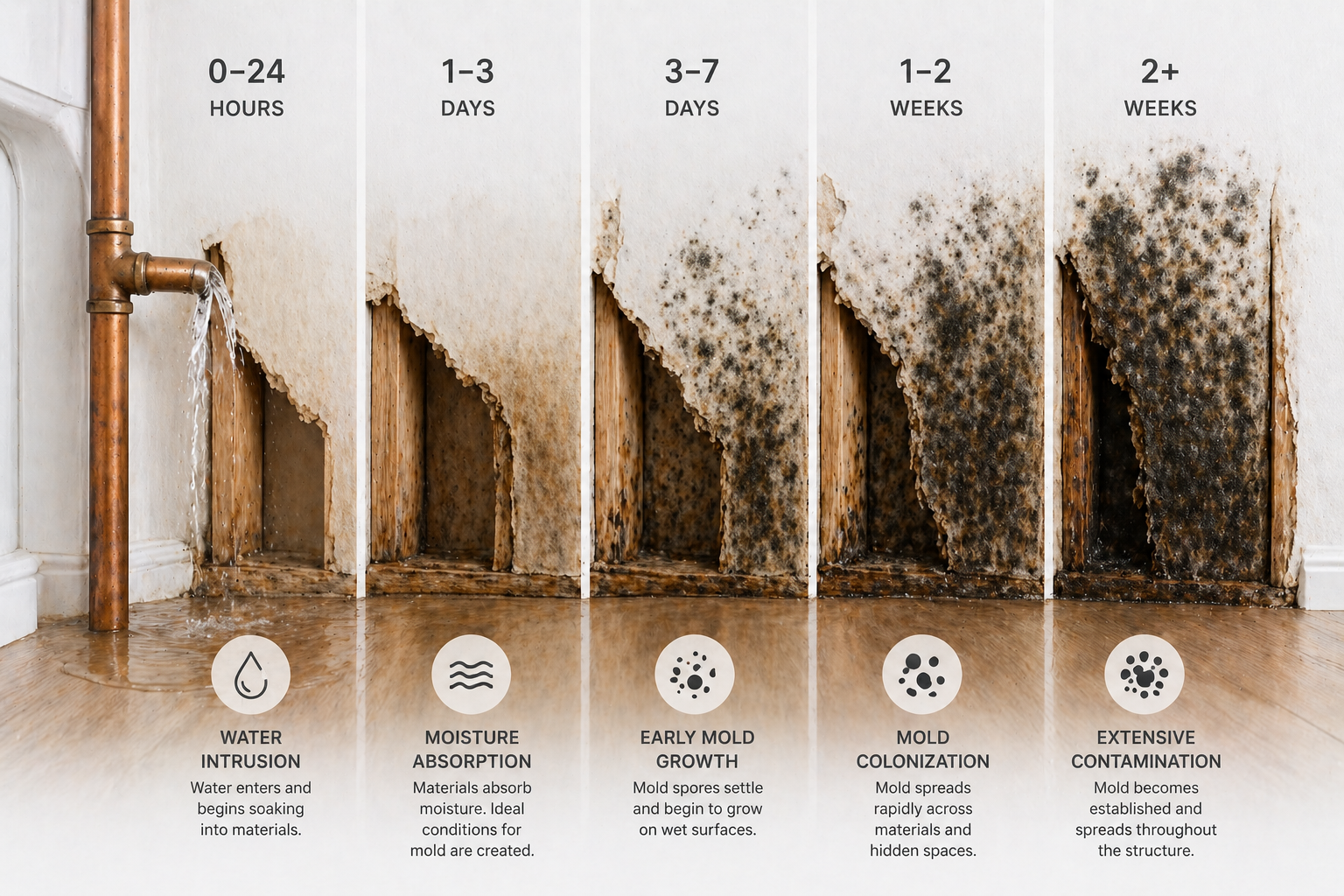
The figure cited most consistently in building science and environmental health literature is that mold can begin growing on wet building materials within 24 to 48 hours of a moisture event. This is not a worst-case scenario — it is the standard window under typical indoor conditions.
The EPA’s mold course materials use this timeline as a foundational reference point, and the IICRC S500 Standard for Water Damage Restoration structures its drying urgency recommendations around it. The 24 to 48 hour window is why water damage restoration is classified as a time-critical service — not because of the water itself, but because of what the water enables if materials are not dried within that window.
In Florida, where ambient humidity is persistently high and temperatures remain warm year-round, this timeline may be even shorter. Mold spores germinate faster in warm, humid conditions, and Florida’s indoor environments — particularly unconditioned spaces like attics, crawl spaces, and wall cavities — can reach temperatures and humidity levels that are close to optimal for mold growth for much of the year.
What Happens in the First 24 Hours
Within the first 24 hours of a water intrusion event, mold spores that are already present on building surfaces — which is virtually always, since spores exist in all indoor environments — begin to germinate where moisture conditions are adequate. Germination does not produce visible growth. It is the beginning of the biological process that leads to it.
During this period, the water is also continuing to move. Water in a building does not stay where it landed. It follows the path of least resistance — through flooring assemblies, along framing members, down inside wall cavities, across ceiling planes. A roof leak that appears to have wet a two-foot area of ceiling may have traveled six feet in each direction through the ceiling assembly by the time it becomes visible at the surface.
This migration is why moisture mapping conducted immediately after a water event consistently finds a larger affected area than visual inspection alone would suggest. What is visible at the surface represents where the water broke through — not where the water is.
24 to 72 Hours: Active Germination
Between 24 and 72 hours after the moisture event, germinated spores begin producing hyphae — the thread-like structures that mold uses to anchor into and extract nutrients from organic building materials. This is the phase during which the colony establishes itself within the material rather than simply on its surface.
This distinction matters practically. Surface mold — growth that has not yet penetrated the substrate — can sometimes be addressed without removing the affected material. Mold that has established hyphae within drywall paper, wood grain, or insulation has become part of the material. Cleaning the surface at this stage removes the visible growth but leaves the colony intact.
By 72 hours, if wet building materials have not been dried to acceptable moisture content levels, visible surface mold growth is likely to appear in the most heavily affected areas. At this point the colony is established, not just beginning.
72 Hours to One Week: Visible Growth and Expansion
After 72 hours with sustained moisture conditions, visible mold colonies begin to appear and expand. The growth rate from this point depends on the moisture level, the temperature, the type of substrate, and the mold species involved. Under favorable conditions — which Florida’s climate regularly provides — colonies can double in size within 24 hours during active growth phases.
What becomes visible at this stage is also producing spores, which are dispersed into the indoor air and can settle on other surfaces throughout the property. If the HVAC system is operating, it can draw spores from the affected area and distribute them through supply air to every room the system serves. A localized water event that was not addressed within the critical window can produce widespread spore distribution within a week.
According to research published by the National Institute of Standards and Technology (NIST), HVAC systems in buildings with mold-affected components can distribute spores at concentrations that significantly elevate counts throughout the entire served space — not just in the immediate area of the growth.
Beyond One Week: Structural Implications
Mold that has been actively growing for more than a week in structural materials has typically penetrated deeply enough into the substrate that surface cleaning is not a viable remediation approach. The affected material requires removal.
Beyond the mold itself, sustained moisture in structural wood creates a secondary risk — wood rot. The same moisture conditions that support mold growth also support the activity of wood-decay fungi, which break down the structural integrity of framing members, sheathing, and subfloor assemblies over time. A water intrusion event that goes unaddressed for weeks or months may produce both mold contamination and structural damage that extends significantly beyond the originally affected area.
The Building Science Corporation documents wood decay risk as a function of the same moisture threshold that governs mold growth — sustained moisture content above 20 percent in wood framing creates conditions for both biological problems simultaneously.
Why "It Dried Out on Its Own" Is a Risk
One of the most common scenarios encountered in professional mold assessment is a property where a water event occurred, the visible water appeared to resolve — either through evaporation, surface drying, or the intrusion simply stopping — and no professional drying was performed because the situation seemed to have corrected itself.
What looks like a resolved situation at the surface is frequently a different situation inside the wall assembly. Drywall facing may appear dry while the gypsum core remains wet. Flooring may feel dry while the subfloor retains significant moisture. Surface evaporation moves moisture from the material face into the indoor air — which can then deposit that moisture elsewhere in the structure — rather than removing it from the building.
Calibrated drying equipment — dehumidifiers and air movers sized and positioned based on moisture readings — removes moisture from building assemblies by creating conditions that draw it out of the material and extract it from the indoor air. Surface evaporation without this equipment does not accomplish the same result.
The IICRC S500 standard specifies drying goals in terms of material moisture content reaching defined dry standard values, confirmed by instrument readings — not by how the surface looks or feels.
What the Timeline Means in Practice
The 24 to 48 hour window is not a guideline for when to schedule remediation. It is the window within which professional drying needs to begin in order to prevent mold growth from establishing in affected materials. Once growth is established — typically by 72 hours under normal Florida conditions — the conversation shifts from prevention to remediation.
This is why water extraction and structural drying is classified as an emergency service. It is not because wet floors are an emergency in themselves. It is because the biological clock running in the background of every water intrusion event has a short window before the nature of the problem changes fundamentally.
If your property has experienced a water intrusion event — whether recent or in the past — and professional drying was not performed, a moisture assessment is a reasonable next step to confirm whether conditions that support mold growth are present inside the structure. Contact FPT Environmental here.
FPT Environmental LLC provides water extraction, structural drying, mold remediation, moisture mapping, and environmental restoration services throughout South and Central Florida. This article is intended for general informational purposes.

Quick Links
About Us
Academy
Services
Products
Financing
Resources
Academy Policy
Privacy Policy
Refund Policy
Let’s Stay Connected
Join our mailing list for expert insights, seasonal property protection strategies, and updates on the latest in indoor air quality technology directly from FPT Environmental.