What Does Mold Actually Need to Grow?
Mold is not random. It grows where specific conditions allow it to — and understanding those conditions is the first step to understanding why it keeps coming back.
Mold feels like an unpredictable problem. It shows up in places you did not expect, returns after you thought it was handled, and spreads in ways that seem to defy logic. But mold growth is not random. It follows a consistent set of requirements, and when all of them are present simultaneously, growth is not just possible — it is inevitable.
Understanding what mold needs to grow does two things: it explains why Florida properties are particularly susceptible, and it gives you a framework for understanding why addressing the visible mold without addressing the conditions that produced it never resolves the problem permanently.
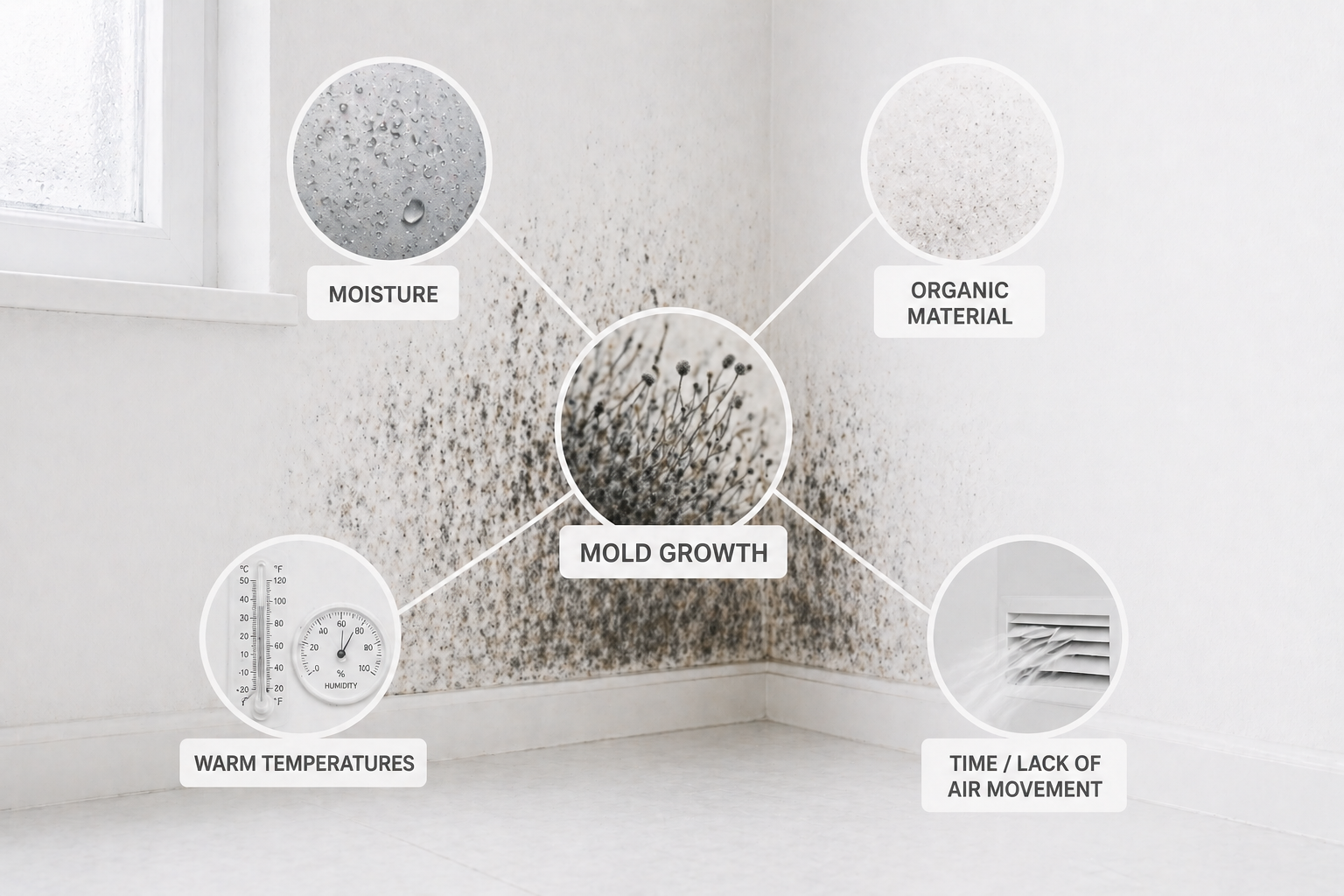
The Four Requirements for Mold Growth
1. Moisture
Moisture is the single most controllable factor in mold growth, and it is the one that determines whether all the other conditions become relevant. Without adequate moisture, mold cannot establish or sustain a colony regardless of what else is present.
Moisture reaches building materials through several pathways — direct water intrusion from leaks, flooding, or storm damage; condensation forming on surfaces where warm humid air contacts cooler materials; and vapor diffusion, where moisture moves through building assemblies as a gas and condenses inside wall or floor cavities.
In Florida, vapor diffusion and condensation are the most underappreciated moisture sources. The Florida Solar Energy Center has documented extensively that Florida’s climate creates a persistent inward vapor drive — hot, humid outdoor air continuously pushes moisture through the building envelope toward the cooler conditioned interior. This means that even without a visible leak or flood event, building materials in a Florida home are under constant moisture pressure that can sustain mold growth in wall cavities, attic spaces, and crawl spaces that are never directly wetted.
The threshold for mold growth is generally considered to be a material moisture content above 20 percent for wood and equivalent levels for other substrates, or sustained relative humidity above 70 percent at the material surface. The IICRC S520 Standard uses these benchmarks as reference points for what constitutes conditions conducive to mold growth in building materials.
2. A Food Source
Mold is a decomposer — it breaks down organic material as its primary metabolic function. In a natural environment, that means fallen leaves, dead wood, and organic debris. In a building, it means the organic components of construction materials.
The most common food sources for indoor mold include:
- Drywall paper facing — the paper surface of standard gypsum board is highly susceptible to mold growth when moisture is present
- Wood framing and sheathing — structural lumber, plywood, and OSB are organic and readily colonized
- Insulation — fiberglass insulation itself is not organic, but it accumulates organic dust that mold uses as a food source; cellulose insulation is directly organic
- Carpet and padding — organic fiber content and accumulated dust provide a food source, and padding retains moisture effectively
- Adhesives and sealants — many construction adhesives contain organic compounds that support mold growth
This is why treating mold-affected drywall or wood with surface products rather than removing the material does not resolve the problem. The food source remains, and as long as moisture is also present, the colony will reestablish.
3. The Right Temperature
Mold grows across a wide temperature range — most indoor mold species are active between 40°F and 100°F (4°C to 38°C), with optimal growth typically occurring between 77°F and 86°F (25°C to 30°C). This range encompasses virtually all occupied indoor environments, and particularly the unconditioned spaces in Florida homes — attics, crawl spaces, and garage areas — that can reach extreme temperatures during summer months.
Temperature alone cannot be practically controlled as a mold prevention strategy in most buildings. It is included here because it explains why mold grows so aggressively in Florida’s attic spaces during summer — the combination of high attic temperatures, moisture infiltration from humid outdoor air, and organic wood substrate creates near-optimal growth conditions that persist for months.
4. Mold Spores
Mold spores are present in virtually every indoor and outdoor environment at all times. They are microscopic, they travel freely through air, and they enter buildings through ventilation systems, open doors and windows, and infiltration through the building envelope. It is not possible to eliminate spores from an indoor environment entirely.
This means that the practical goal of mold prevention is not to eliminate spores — it is to eliminate the conditions that allow those spores to germinate and establish a colony. Spores that land on a surface that is dry, well-ventilated, and does not provide a food source will not grow. Spores that land on a damp organic surface will.
The EPA’s introduction to mold puts it plainly: the way to control mold is to control moisture, because the other three conditions — food source, temperature, and spores — are effectively always present in a building.
Why These Four Conditions Matter Together
Mold requires all four conditions to be present simultaneously. Remove any one of them and growth stops — or never begins. In practice, temperature and spore presence cannot be controlled in most buildings. Food source can be reduced through material selection (mold-resistant drywall, for example) but not eliminated. Moisture is the variable that is both most controllable and most impactful.
This is why every mold problem is fundamentally a moisture problem. The mold is the visible consequence. The moisture condition is the cause. Remediation that removes the mold without identifying and correcting the moisture source leaves three of the four required conditions intact. The fourth — moisture — will return through the same pathway that produced it the first time, and the cycle begins again.
What This Means for Florida Properties Specifically
Florida’s climate makes moisture control uniquely challenging compared to most of the country. The combination of high ambient humidity, frequent rainfall, warm temperatures year-round, and persistent inward vapor drive through building envelopes means that the moisture threshold for mold growth is easier to reach and harder to stay below.
Properties that have experienced any water intrusion event — a roof leak, a pipe failure, storm flooding — and were not thoroughly dried using calibrated equipment are at particularly high risk. Moisture that is absorbed into wall assemblies, subfloors, and insulation during an intrusion event can remain at mold-conducive levels for weeks after the surface appears dry.
According to the EPA, mold can begin growing on wet building materials within 24 to 48 hours of a moisture event. In Florida’s humidity, that window may be shorter.
The Practical Takeaway
Understanding what mold needs to grow reframes how to think about finding it. The question is never just “how do I get rid of this mold?” — it is “which of the four conditions is creating the opportunity, and can I eliminate it?”
In most cases, the answer points to moisture. Identifying where it is coming from, how it is reaching the affected material, and whether it is still active at the time of discovery is the foundation of any effective response.
If you have found mold in your property — or if you have had it remediated before and it has returned — FPT Environmental can help identify the moisture conditions driving it. Contact us here.
FPT Environmental LLC provides mold remediation, moisture mapping, indoor air quality testing, and environmental restoration services throughout South and Central Florida. This article is intended for general informational purposes.
Quick Links
About Us
Academy
Services
Products
Financing
Resources
Academy Policy
Privacy Policy
Refund Policy
Let’s Stay Connected
Join our mailing list for expert insights, seasonal property protection strategies, and updates on the latest in indoor air quality technology directly from FPT Environmental.