Can I Use Bleach to Remove Mold? The Truth About DIY Cleaning
Bleach is the most common first response to finding mold — and one of the least effective. Here is what it actually does, what it doesn’t, and when it stops being enough.
Bleach is in almost every household. It is inexpensive, it is familiar, and when you spray it on a dark mold stain and watch the color disappear, it feels like the problem is solved. This is the most misleading thing about using bleach on mold — it works exactly well enough to make you think it worked completely.
The reality is more complicated, and understanding it matters because the gap between appearing to fix a mold problem and actually fixing it is where the problem gets worse.
What Bleach Actually Does to Mold
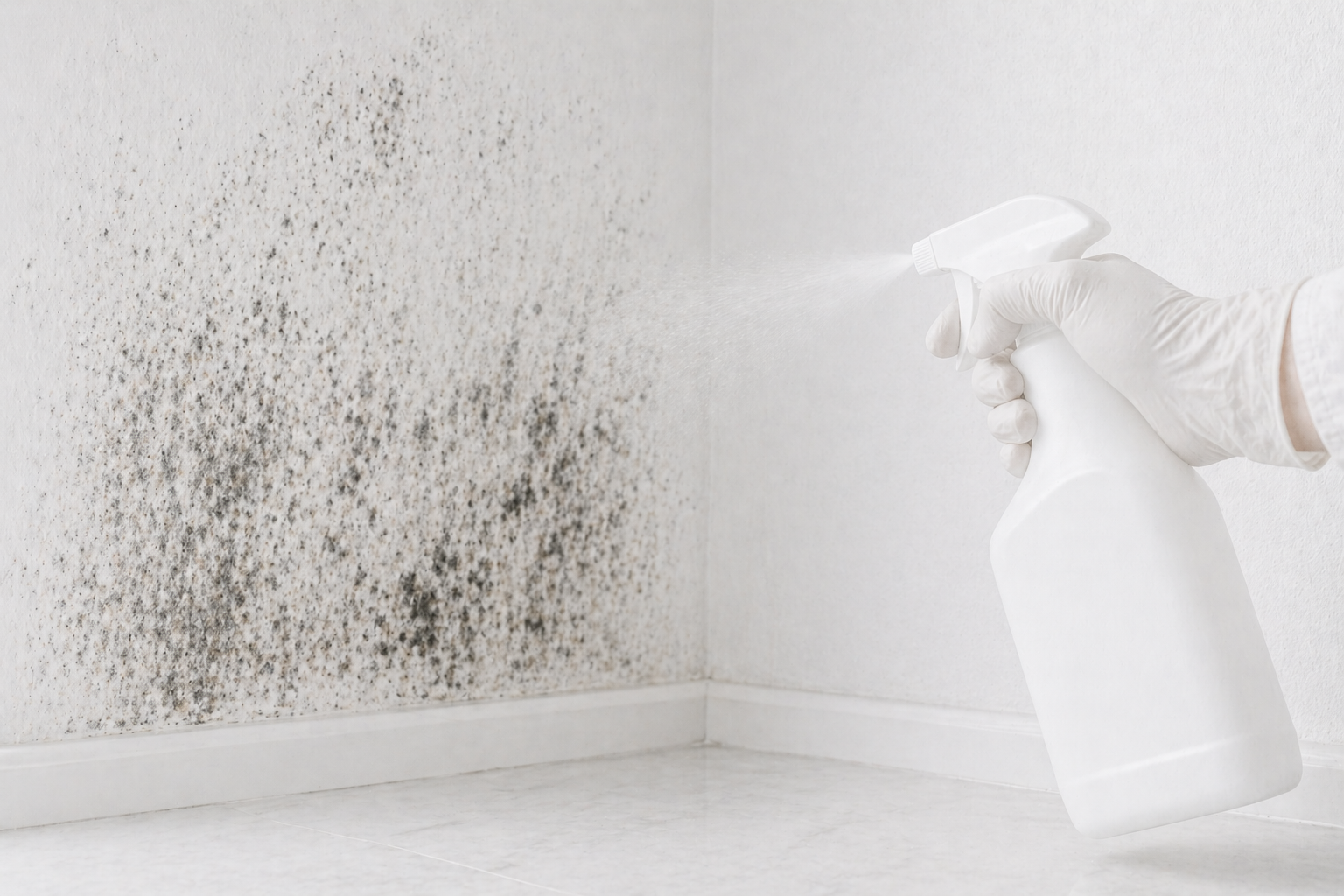
When bleach contacts mold on a non-porous surface — glazed tile, glass, a sealed countertop — it kills the surface growth and removes the visible staining. On these surfaces, bleach can be genuinely effective as a cleanup tool for minor, contained surface mold.
The problem is that most mold in a home does not grow on non-porous surfaces. It grows on drywall, wood framing, grout, insulation, and other porous and semi-porous materials. On these surfaces, bleach behaves very differently.
Bleach is approximately 95 percent water. When you apply it to a porous material like drywall, the chlorine component — the active ingredient — does not penetrate deeply into the material. It stays near the surface. The water component, however, soaks in. The result is that the surface appearance of the mold is addressed while the root structure of the colony, which has grown into the material below the surface, is left intact. The water you have introduced in the process may actually provide additional moisture that supports continued growth.
This is not a fringe opinion. The EPA’s guidelines on mold remediation specifically state that the use of biocides such as bleach is not recommended as a routine practice in mold remediation, and that the physical removal of contaminated material is the primary method for addressing mold in porous substrates.
Why the Mold Comes Back
If you have cleaned a mold spot with bleach and found it returning within weeks, this is why. The colony was not eliminated — the surface growth was removed and the visible staining was bleached out, but the mycelium (the root-like structure mold uses to anchor into and feed from the material) remained. Given the same moisture conditions, regrowth is predictable.
There is a secondary issue as well. Applying bleach to mold — particularly in a poorly ventilated space — can cause mold to release a burst of spores as a stress response. This is a documented biological defense mechanism. Instead of containing the problem, aggressive surface cleaning without proper containment can spread spores to adjacent areas that were previously unaffected.
The Centers for Disease Control and Prevention (CDC) recommends that mold cleanup in areas larger than about 10 square feet be handled by professionals with appropriate protective equipment and containment protocols — specifically because of the risk of spore dispersal during cleaning.
When DIY Cleaning Is and Isn't Appropriate
This is not an argument that bleach is never useful or that any amount of surface mold requires a professional remediation. The practical guidance looks like this:
DIY cleaning may be appropriate when:
- The affected area is small — roughly 10 square feet or less
- The surface is non-porous (glazed tile, glass, sealed hard surfaces)
- The moisture source that caused the growth has been identified and corrected
- There is no reason to suspect the mold has penetrated into the wall or substrate behind the surface
- The affected person has no respiratory conditions or elevated health sensitivity
Professional assessment is warranted when:
- The affected area is larger than 10 square feet
- The mold is growing on drywall, wood, insulation, or any porous material
- The mold has returned after previous cleaning attempts
- You do not know what caused the moisture that allowed it to grow
- The smell persists after the visible mold has been cleaned
- Anyone in the household has asthma, respiratory conditions, or a compromised immune system
The size threshold is not arbitrary. The EPA’s guidance uses 10 square feet as the dividing line between a minor surface issue and a situation that indicates a larger, likely structural moisture problem that surface cleaning will not resolve.
What Professional Remediation Does Differently
Where bleach addresses the surface, professional remediation addresses the material. Contaminated drywall, insulation, and wood that has been penetrated by mold growth is removed entirely — taking the colony with it rather than attempting to kill it in place. HEPA air scrubbers run continuously during the work to capture spores that become airborne during removal. The work area is sealed with containment barriers to prevent cross-contamination to adjacent spaces.
After material removal, remaining structural surfaces are HEPA vacuumed and treated with EPA-registered antimicrobial agents appropriate for the specific substrate. Where warranted, specialty coatings are applied to create a surface environment that inhibits future microbial establishment.
The project is not considered complete until clearance testing — air sampling conducted by a licensed assessor independent of the remediator — confirms that spore levels have returned to acceptable ranges. This is the verification step that bleach-and-bucket cleaning cannot provide.
The More Important Question
Before asking whether bleach will remove the mold, the more useful question is: what caused the moisture that allowed it to grow, and is that source still active?
Mold is always a secondary problem. It grows where moisture conditions allow it to. Addressing the visible mold without identifying and correcting the moisture source — whether that is a slow pipe leak, inadequate ventilation, a compromised vapor barrier, or Florida’s outdoor humidity infiltrating through gaps in the building envelope — means the conditions for regrowth remain in place regardless of what cleaning product was used.
If you have found mold in your home and want to understand whether it is something you can handle yourself or something that warrants a professional assessment, contact FPT Environmental. We will give you an honest answer.
FPT Environmental LLC provides mold remediation, moisture mapping, indoor air quality testing, and environmental restoration services throughout South and Central Florida. This article is intended for general informational purposes.
Quick Links
About Us
Academy
Services
Products
Financing
Resources
Academy Policy
Privacy Policy
Refund Policy
Let’s Stay Connected
Join our mailing list for expert insights, seasonal property protection strategies, and updates on the latest in indoor air quality technology directly from FPT Environmental.